UK Live Betting Horse Racing: The Data-Driven Guide to In-Play Wagering
Data-driven insight for smarter race-day decisions.
By Horse Racing Betting Analyst
 Available in US
Table of Contents
- The Five Things This Guide Will Change About Your Race-Day Approach
- Why UK Live Horse Racing Betting Demands a Different Approach
- The UK Horse Racing Betting Market in Numbers
- How In-Play Horse Racing Betting Works
- Core Bet Types for Live Horse Racing
- Exchange vs Bookmaker: Which Model Suits In-Play Punters
- Best Odds Guaranteed and How It Affects Live Markets
- In-Play Strategy: From Back-to-Lay to Scalping
- Mobile Betting and the Live Racing Experience
- Regulation, Tax, and What Changed in 2025
- The UK Live Betting Calendar: Key Fixtures
- Staying in the Game: A Quick Note on Discipline and Safety
- Common Questions About UK Live Horse Racing Betting
The Five Things This Guide Will Change About Your Race-Day Approach
- UK remote horse racing betting is a £766.7 million GGY market — second only to football — with over 80% of race-day wagers now placed on mobile devices.
- In-play odds shift fastest in the 30-60 seconds after the off, creating exploitable windows for punters who understand price formation and stream-delay dynamics.
- The regulatory landscape changed sharply in 2025: affordability-check thresholds dropped to £150 monthly net deposits, and Remote Gaming Duty rose to 40% (though racing itself was carved out at 15%).
- Exchange trading, back-to-lay setups, and disciplined staking are the three pillars of consistent in-play profitability — this guide maps each one.
- Every statistic and strategy in this guide draws on Gambling Commission data, BHA racing reports, and nine years of first-hand in-play market analysis.
Why UK Live Horse Racing Betting Demands a Different Approach
I placed my first in-play bet on a jumps race at Sandown in 2017 — a novice hurdler drifting from 5/1 to 12/1 as the field rounded the back straight, only to storm home by three lengths. The payout was decent, but what hooked me was the realisation that the market had been wrong in real time, and the window to exploit that mistake lasted about forty-five seconds. Nine years later, I still chase those windows. The difference is that I now understand why they open, how quickly they close, and what separates a repeatable edge from a lucky punt.
Live horse racing betting in the UK is not a niche within a niche. Remote wagering on British racing generated £766.7 million in Gross Gambling Yield in the year ending March 2025 — a figure that places it second only to football in the UK’s online betting hierarchy. Roughly 15% of British adults bet on the horses at least once a month, and in the 25-34 age bracket, that number climbs to 32%. Those are not small numbers. They describe a market with serious liquidity, fierce operator competition, and — crucially — enough inefficiency in live markets to reward punters who prepare.
Yet most of the content aimed at these punters reads like a bookmaker’s promotional leaflet. Lists of welcome offers. Vague gestures toward “watching the odds”. A paragraph on each-way and a bullet list of festival dates. Nothing about how in-play prices actually form, nothing about the regulatory upheaval reshaping the entire market, and almost nothing grounded in real data. This guide takes a different approach. I have built it around the numbers, the mechanics, and the strategic decisions that matter once the stalls open — or, in the case of a jumps race, once the tape goes up.
Whether you have been betting on the turf for decades or you are opening your first account this season, the structure is the same: understand the market, understand the tools, understand the rules, then act. Every section that follows serves one of those four functions.
The logical starting point is the market itself — how large it is, where the money flows, and why those numbers should shape the way you think about every race-day wager.
The UK Horse Racing Betting Market in Numbers
Three years ago, I sat down with a spreadsheet and tried to map exactly where UK punters’ money goes on a typical Saturday afternoon of racing. The exercise was humbling. The scale of the British horse racing betting market dwarfs what most individual bettors imagine, and the way that money is distributed between operators, the sport itself, and the taxman has direct consequences for the odds you see on your screen.
UK Gambling Market (2026)
£17.2 billion total GGY across all verticals
Remote Horse Racing GGY
£766.7 million in the year ending March 2025
Online Share of All UK GGY
46% — nearly half of all gambling yield is generated online
Active Online Gambling Accounts
24.4 million at the end of the last reporting quarter
Global Horse Racing Market
$511.55 billion in 2026, projected to reach $1,072.56 billion by 2035
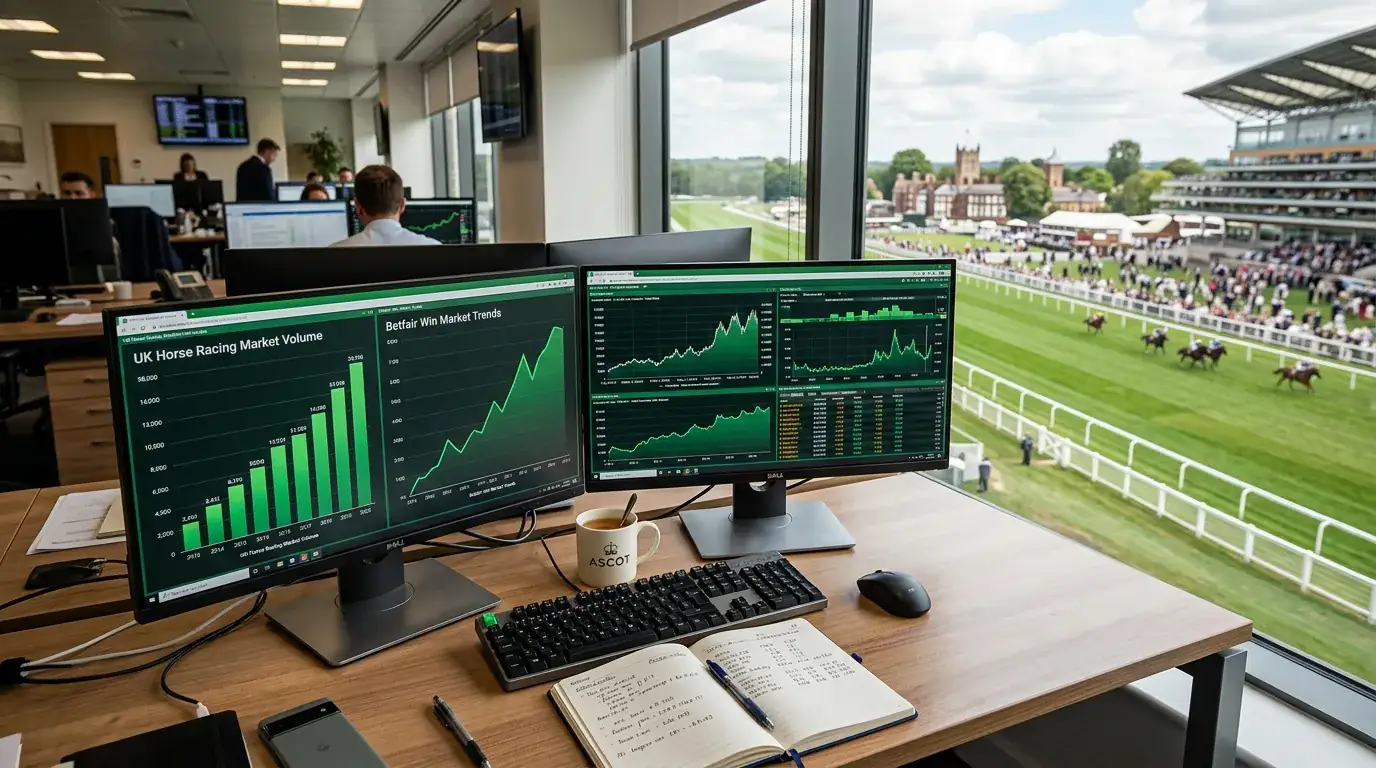
The UK gambling market is valued at £17.2 billion in 2026, and online gambling accounts for 46% of all Gross Gambling Yield generated in Britain. Within that digital slice, horse racing holds a distinctive position. It is the second-largest remote betting vertical by revenue, trailing football but comfortably ahead of tennis, cricket, and every other sport. The £766.7 million GGY figure from the Gambling Commission’s annual report is not turnover — it is the money operators kept after paying out winners. Total amounts wagered on British racing run into the billions.
To put the domestic market in a global frame: the worldwide horse racing industry is valued at $511.55 billion in 2026, with projections suggesting it will double to over a trillion dollars by 2035 at a compound annual growth rate of 8.57%. The UK’s share of that global pie is disproportionately large relative to the country’s size, driven by the depth of the fixture list, the quality of the bloodstock, and — above all — the sophistication of the betting infrastructure.
There are 24.4 million active online gambling accounts in the UK. That is roughly one account for every 2.3 adults in the country — though many punters hold accounts with multiple operators, which inflates the headline number. What it does confirm is that the infrastructure for live wagering is already in the hands of nearly every adult who wants it.
The revenue numbers are impressive, but the trend beneath them is more nuanced. Online turnover on horse racing has dropped by £1.6 billion since 2022 in nominal terms — roughly £3 billion when adjusted for inflation. That decline is not driven by waning interest in the sport. Racecourse attendance hit 5.031 million in 2025, the first time it crossed the five-million threshold since 2019. The gap between growing live attendance and shrinking online turnover points to a regulatory story I will unpack in the section on affordability checks. For now, the key insight is simple: the market is enormous, liquid, and contested — but it is also shifting in ways that create both risk and opportunity for in-play punters.
How In-Play Horse Racing Betting Works
The moment that changed my understanding of in-play betting was not a big win. It was watching a 2/1 shot stumble slightly at the second-last hurdle in a Wetherby novice race — nothing dramatic, the horse recovered in two strides — and seeing its exchange price spike from 2.8 to 6.0 in under five seconds. Within fifteen seconds, it was back to 3.2. Anyone who laid at 6.0 and backed at 3.2 locked in a profit without caring who won. That sequence, compressed into half a minute, contains every principle of in-play horse racing betting worth knowing.
In-play betting — also called in-running or in-race betting — is the practice of placing wagers on a horse race after it has started. Unlike pre-race markets, where odds reflect form analysis, going conditions, and market sentiment, in-play prices respond to what is actually happening on the track in real time.
The mechanics are deceptively simple. Once the race begins, bookmakers and exchanges continue to accept bets, but the odds update rapidly to reflect the evolving probability of each runner winning. A horse that breaks well and leads the field will shorten; a horse that gets boxed in or loses ground will drift. The speed of these adjustments depends on the platform — exchanges typically update faster than fixed-odds bookmakers because prices are set by other punters rather than by a trading team — but in both cases, the fundamental principle is the same: the market is pricing new visual information in real time.
In-Play Bet: A Step-by-Step Walkthrough
1. You identify a six-furlong sprint at Ascot with eight runners. Pre-race, Runner A is 4/1 (5.0 decimal).
2. The stalls open. Runner A breaks slowly and sits last of eight at the two-furlong mark. Its in-play price drifts to 14.0 on the exchange.
3. At the furlong pole, Runner A has moved through the field and sits second, two lengths off the leader. The price has crashed to 2.5.
4. If you backed Runner A at 14.0, you can now lay at 2.5 to guarantee a profit regardless of the result — or let the bet ride if you believe the horse will get up on the line.
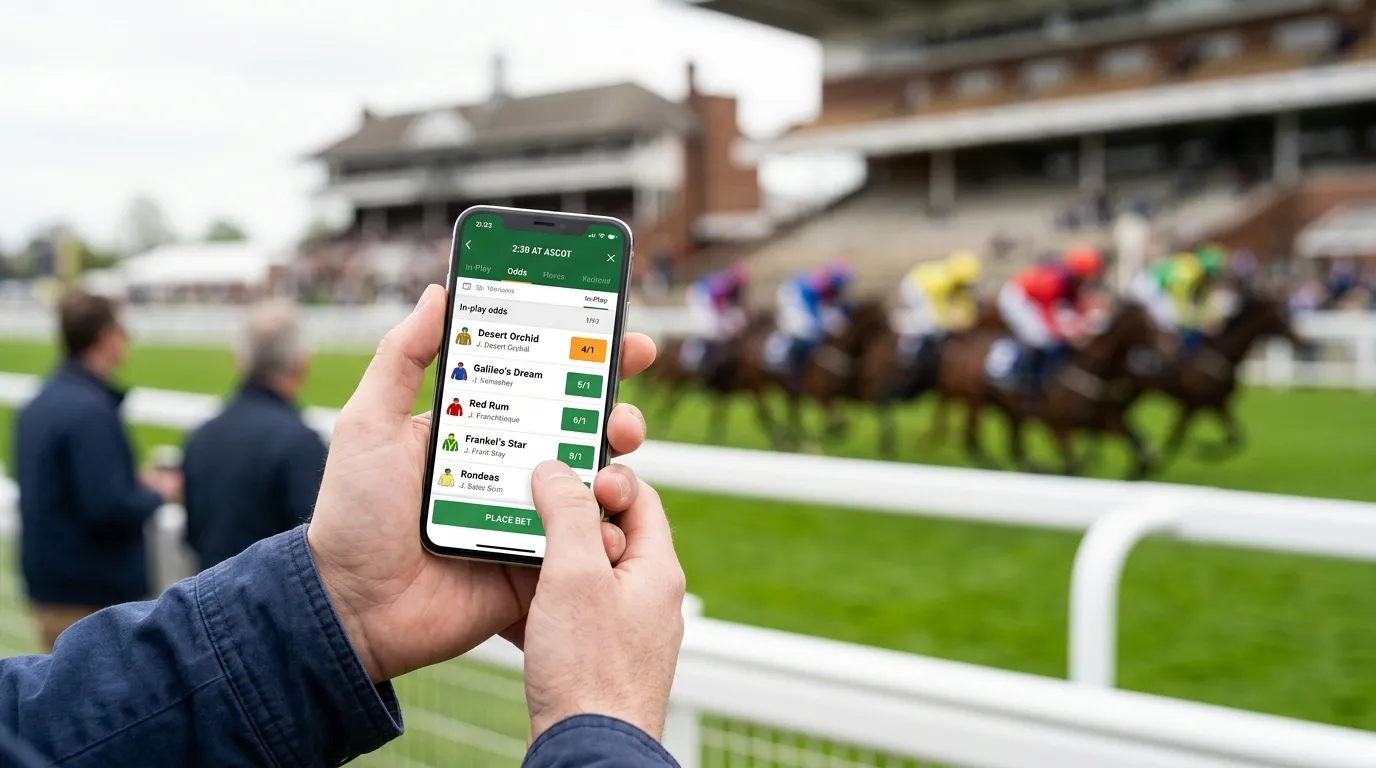
What makes UK horse racing uniquely suited to in-play wagering is the combination of short race durations (one to five minutes), high market liquidity at major meetings, and live video streams that let punters make visual assessments rather than relying on price movement alone. At the Cheltenham Festival in 2024, each-way wagers grew by 25% year on year — a clear signal that punters are increasingly comfortable making complex decisions in real time, even from a phone screen.
In-play horse racing is structurally different from in-play football or tennis. A football match lasts ninety minutes with relatively few game-changing moments; a horse race compresses its drama into ninety seconds to five minutes. That compression means the in-play window is short, volatile, and unforgiving — but rich with opportunity for punters who can read a race visually.
Odds Movement During a Race
Every horse in a race carries two sets of odds at any given moment: the pre-race price, which reflects form, conditions, and market money, and the in-play price, which reflects what is actually happening on the track. The gap between these two numbers is where value lives — and where most punters lose money because they confuse the two.
How In-Play Odds Move: A Flat Sprint Example
Pre-race: Runner B is 3/1 (decimal 4.0), implying a 25% win probability.
After 2 furlongs: Runner B is tracked in third, travelling well. Price tightens to 2.8 (35.7% implied probability).
After 4 furlongs: Runner B challenges for the lead. Price crashes to 1.8 (55.6% implied probability).
Final furlong: Runner B is headed by a closer. Price bounces to 3.5 (28.6% implied probability).
Result: Runner B finishes second. Anyone who backed at 4.0 pre-race loses their stake. Anyone who backed at 2.8 and laid at 1.8 locked in a profit without needing the horse to win.
The key dynamic is that in-play prices overreact to visual stimuli. A horse that takes the lead early in a two-mile chase will see its price collapse far more than its actual winning probability has increased — the market is dominated by recreational punters who bet what they see, not what they calculate. Professional traders exploit this systematically. They know that front-runners in National Hunt races tire at a statistically predictable rate, and that the market will not price these nuances correctly until it is too late.
The sharpest moves happen in two windows: the first thirty seconds after the off (when the market reprices the draw, break speed, and early position) and the final two furlongs (when closing speed and stamina become visible). Between these windows, prices drift gradually unless something dramatic occurs — a fall, a stumble, a jockey pulling up. Understanding this rhythm is essential for anyone looking to develop a systematic in-play horse racing strategy.
Stream Delay, Drone Feeds, and the Latency Question
Here is the uncomfortable truth about live horse racing betting that no bookmaker’s marketing team will mention: the stream you are watching is not live. It is delayed — typically by one to three seconds on mainstream platforms, sometimes more on mobile networks under load. That delay is not a glitch. For operators, it is a deliberate buffer that allows their trading algorithms to adjust prices before punters can react to what they see on screen.
The latency gap is the single biggest structural disadvantage for retail in-play punters. A one-second delay on a six-furlong sprint that lasts seventy seconds means you are always operating on information that is roughly 1.4% stale. In fast-moving markets, that is enough to turn a value bet into a losing one. Awareness of this delay should shape which races you target for in-play bets and how aggressively you chase short-priced moves.
Drone camera feeds, which some professional operations access through private arrangements with racecourses, reduce this lag significantly. The technology gap is measured in fractions of a second — but in a market that reprices every heartbeat, those fractions translate into points of value. I raise this not to discourage anyone, but because understanding the information hierarchy is the first step toward choosing your battles wisely. Target races where the key price move unfolds over ten to fifteen seconds (National Hunt staying races), not races where it happens in two (short sprints on fast ground), and the latency disadvantage shrinks to something manageable.
Core Bet Types for Live Horse Racing
I once sat next to a man at Newmarket who had been betting on horses for thirty years and did not know what a forecast was. He is not unusual. Most UK punters use two or three bet types out of a menu of a dozen, and the ones they ignore are often the ones best suited to in-play conditions.
The market segmentation data tells the story clearly: win bets account for 36% of all horse racing wagers, each-way bets for 22%, forecast and tricast bets for 17%, single bets for 15%, and multiples for 10%. That 17% forecast/tricast share is higher than most people assume, and it reflects a growing appetite among experienced punters for exotic bets that offer higher payouts in exchange for greater precision.
Win Bet
The simplest wager: you pick a horse, it must finish first. In-play, win bets are the default tool for punters who back a horse they see travelling well and believe will improve its position. The odds reflect the market’s real-time assessment of that horse’s probability of winning — nothing more.
Each-Way Bet
Two bets in one: a win bet and a place bet at a fraction of the win odds. The place terms (how many positions pay out, at what fraction) vary by field size and race type. Each-way bets are the backbone of festival betting and large-field handicaps, where backing a 20/1 shot to finish in the first four can return a profit even without a win.
Forecast and Tricast
A forecast requires you to predict the first two finishers in order (or in any order, with a combination forecast). A tricast demands the first three in exact order. These bets offer outsized returns relative to stake but require deeper race analysis. The Computer Straight Forecast (CSF) payout is calculated after the race based on actual SP odds, not fixed beforehand.
Starting Price (SP) — the official odds of a horse at the moment the race begins, determined by on-course bookmakers. SP is used to settle many types of bets, including forecasts and tricasts, and serves as the benchmark against which Best Odds Guaranteed payouts are calculated.
For in-play purposes, the key distinction is between bets available during a race and those that are not. Win bets and, on some platforms, each-way bets are available in-running. Forecasts, tricasts, and accumulators are pre-race only. This narrows the in-play toolkit to its most elemental form: back a horse to win, or — on an exchange — lay one to lose. A well-timed in-play win bet combined with a pre-race lay can replicate the risk profile of far more complex wager types.
Each-Way Betting at a Glance
Each-way betting deserves its own moment because it is simultaneously the most popular and the most misunderstood bet type in UK racing. The concept is straightforward: your stake is split into two equal parts — one on the horse to win, one on it to place. The place portion pays out at a fraction of the win odds, typically one quarter for most races and one fifth for handicaps with large fields.
Each-Way Payout: A Quick Calculation
You back a horse each-way at 10/1 with a £10 total stake (£5 win, £5 place). Place terms: 1/4 odds, first four places.
If the horse wins: Win part returns £5 x 10/1 = £50 + £5 stake = £55. Place part returns £5 x 10/4 (2.5/1) = £12.50 + £5 stake = £17.50. Total return: £72.50 on a £10 stake.
If the horse finishes second, third, or fourth: Win part loses (-£5). Place part returns £17.50. Net return: £12.50 on a £10 stake — a profit of £2.50.
If the horse finishes fifth or worse: Both parts lose. Total loss: £10.
The place terms are where the value equation gets interesting. In a five-to-seven-runner race, only the first two places pay out. In an eight-to-fifteen-runner race, three places pay. In a sixteen-plus-runner handicap, four places. Some bookmakers extend to five or six places during major festivals — those extra-place promotions at Cheltenham and Aintree can shift the expected value of an each-way bet from negative to positive for outsiders in big fields. If you want to dig deeper into when and why those shifts matter, I have written a full breakdown of each-way betting in horse racing with worked examples for every field-size scenario.
Exchange vs Bookmaker: Which Model Suits In-Play Punters
For the first five years of my betting career, I used fixed-odds bookmakers exclusively. Then I opened an exchange account, placed a lay bet on a 6/4 favourite in a Kempton maiden, watched it finish third, and collected a clean profit without the horse doing anything for me. It was a philosophical shift as much as a practical one: the exchange model turns punters into market makers, and once you understand that distinction, you cannot unsee it.
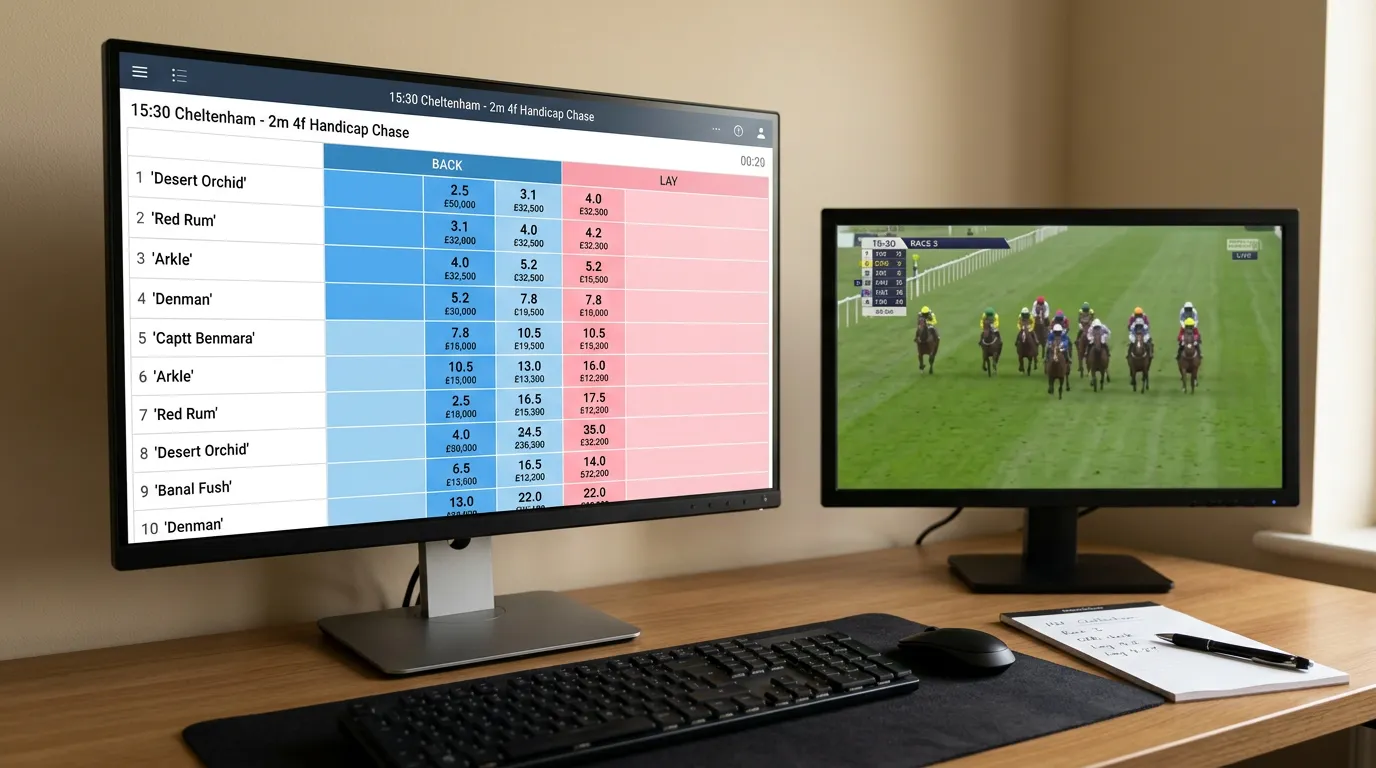
A traditional bookmaker sets odds, takes your bet, and pays out if you win. Their margin — the overround built into every market — is how they profit. An exchange operates differently. It matches backers (who think a horse will win) with layers (who think it will not) and charges a commission on net winnings, typically between 2% and 5%. The exchange does not care who wins; it earns commission either way. This structural difference has two major consequences for in-play punters. First, exchange odds are almost always better than bookmaker odds, because the overround is replaced by a smaller commission. Second, you can lay a horse — effectively bet against it — which is impossible with a traditional bookmaker.
| Feature | Traditional Bookmaker | Betting Exchange |
|---|---|---|
| Who sets the odds | The operator’s trading team | Other punters in the market |
| Margin structure | Overround (typically 110-130%) | Commission on net profit (2-5%) |
| Lay betting available | No | Yes |
| In-play speed | Moderate (prices managed) | Fast (market-driven) |
| Best Odds Guaranteed | Yes (most operators) | No |
| Liquidity risk | None (operator absorbs all bets) | Yes (your bet may go unmatched) |
| Cash out | Operator-controlled pricing | Manual via lay/back at market price |
The revenue scale of major operators matters here. Flutter Entertainment reported $15.91 billion in global revenue for 2025, up 17% year on year — a figure that underscores the infrastructure, data, and capital backing the prices on your screen. Your counterparty in any bet is not a casual opponent; recognising that shapes how you approach market selection and timing.
Do
- Use exchanges for in-play trading where you intend to back and lay the same horse
- Compare exchange odds against bookmaker prices before every pre-race bet
- Start with high-liquidity markets (major UK meetings) if you are new to exchanges
Don’t
- Lay short-priced horses on the exchange without understanding your full liability
- Assume exchange odds are always better — BOG on a bookmaker can outperform exchange prices if the SP drifts
- Trade in-play on the exchange in low-liquidity races (midweek evening cards at minor tracks) where your orders may go unmatched
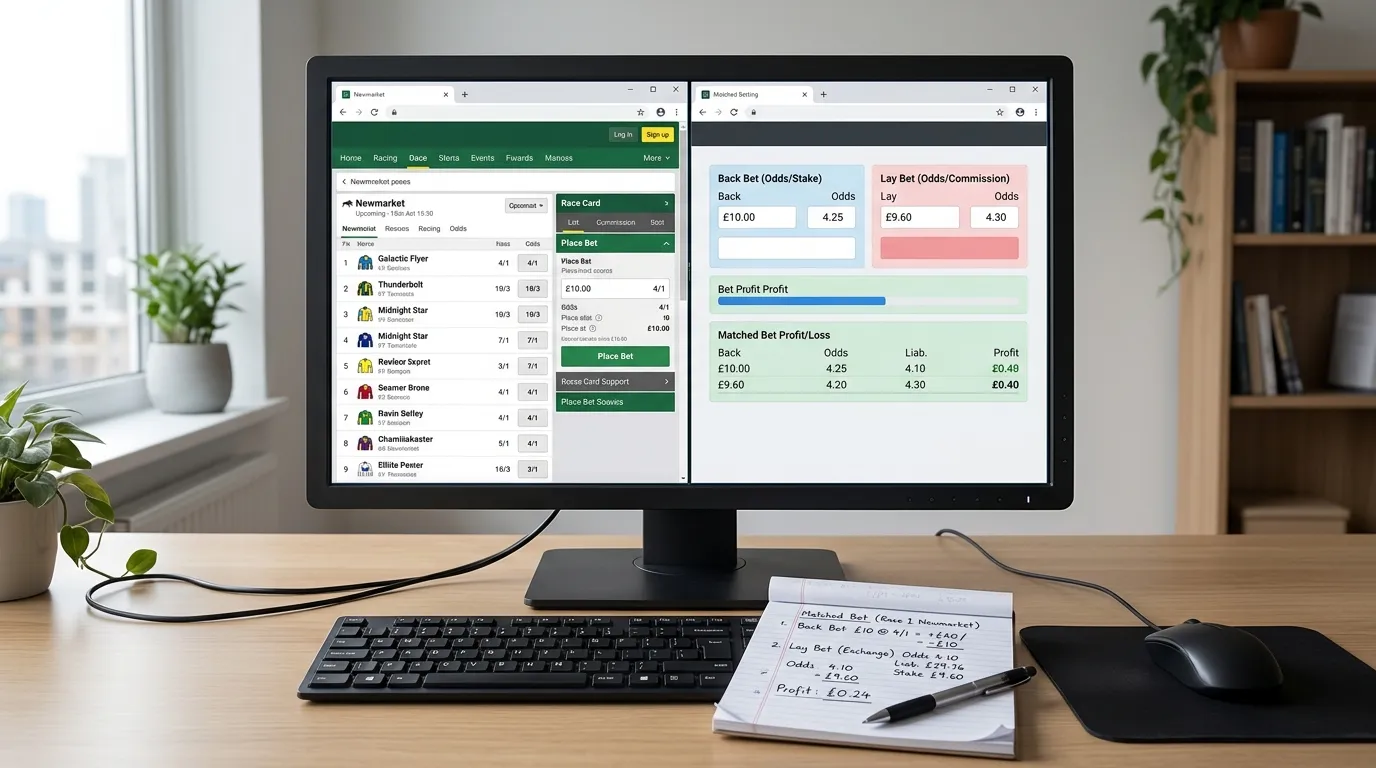
The choice between exchange and bookmaker is not binary. Most successful in-play punters I know use both — bookmakers for BOG-backed pre-race positions and each-way bets in big fields, exchanges for in-play trading and laying. The detailed mechanics of UK horse racing betting exchanges, including commission structures and matched-bet scenarios, deserve their own treatment.
Best Odds Guaranteed and How It Affects Live Markets
Last March, I backed a horse ante-post at 8/1 for a Cheltenham handicap hurdle. By the time the race went off, it had shortened to 5/1. Best Odds Guaranteed meant I was paid at 8/1 anyway — a 60% uplift on what I would have received had I taken the Starting Price. Over a season of 200-odd bets, those BOG payouts add up to a meaningful improvement in overall return. It is, without exaggeration, the single most valuable standard promotion in UK horse racing betting.
Best Odds Guaranteed means that if you take a price on a horse before the race and the Starting Price (SP) is higher, you are paid at the better price. If the SP is lower, you keep your original price. In either direction, you get the best outcome. Most major UK operators activate BOG from early morning on the day of the race, though activation times vary — some start at 08:00, others at 09:00 or even 10:00.
What BOG Covers
Pre-race win and each-way bets on UK and Irish horse racing (some operators extend to selected international meetings)
Activation Window
Typically from 08:00 or 09:00 on race day until the off
In-Play Bets
BOG does not apply to bets placed after the race has started
Excluded Markets
Forecasts, tricasts, and ante-post bets placed more than 24 hours before the race are usually excluded
The interaction between BOG and live markets is subtler than it appears. BOG incentivises early betting, which provides bookmakers with market-making data about money flow. The pre-race price you take at 09:00 is a negotiation between your assessment and the operator’s opening tissue price. If the horse shortens, BOG ensures you keep your edge. If it drifts, you are paid at the higher SP. It is a one-way ratchet in the punter’s favour, sustained by competitive pressure: no major UK bookmaker can drop BOG without losing racing customers to rivals.
The catch — and there is always a catch — is that BOG does not extend to in-play bets. Once the race starts, the price you take is the price you get. This creates a strategic fork: for horses you like pre-race, take the early price under BOG; for horses you want to back in-running, you are operating without that safety net. Knowing which races and which runners favour each approach is a core skill, and it is one reason I always encourage punters to learn how horse racing odds are formed before committing serious money.
In-Play Strategy: From Back-to-Lay to Scalping
If someone asks me to summarise in-play horse racing strategy in a single sentence, I tell them: find spots where the market overreacts to visual information, then trade against the overreaction. That is the core idea. Everything else — back-to-lay, scalping, swing trading, cash-out timing — is a variation on that theme, applied to different race types and different time horizons.
Back-to-lay is the entry point for most in-play traders. You back a horse pre-race (or early in-running) at a higher price and lay it at a lower price once it moves into a winning position, locking in a profit regardless of the outcome. The margin per trade is small — often just a few ticks on the exchange — but compounded over hundreds of races, it builds. Scalping takes this a step further: you trade tiny price movements on short-priced horses within the first few seconds of a race, entering and exiting positions in rapid succession. It requires fast execution and low-latency data, and it is not for everyone — but for punters with the right temperament and technology, it produces the most consistent returns of any in-play approach I have encountered.
Swing trading is the in-play strategy best suited to National Hunt racing, where races last three to five minutes and prices trend over longer periods. Instead of scalping one-tick moves, a swing trader identifies a horse that the market has mispriced at a structural turning point in the race — the top of the hill at Cheltenham, the Canal Turn at Aintree — and holds the position for thirty seconds to a minute. The returns per trade are larger, but so is the variance.
Cash out — the ability to settle a bet early at a price determined by the bookmaker — is the retail punter’s version of in-play trading, and it is worth treating with caution. The cash-out price offered by a bookmaker always includes a margin — you will consistently get a worse price cashing out through a bookmaker than you would by manually laying on an exchange. I use cash out as a convenience tool when I cannot access the exchange in time, never as a primary strategy.
Each of these approaches demands its own risk framework, staking discipline, and race-selection criteria. I have built a dedicated guide that walks through every setup in detail, including worked examples and common errors.
Strategy is only half the equation. The other half is the device in your pocket — and how well it handles the demands of live race-day betting.
Mobile Betting and the Live Racing Experience
I spent Cheltenham 2024 standing in the Guinness Village, phone in one hand, pint in the other, placing each-way bets between races while watching replays on a screen thirty metres away. I was not unusual. More than 80% of all bets placed during that Festival came through mobile devices — a figure that has climbed steadily from around 60% five years ago and shows no sign of plateauing. The shift from desktop to mobile is not just a convenience story. It has changed the way live horse racing markets behave.
The average race-day punter now has three to four bookmaker apps on their phone, plus an exchange app and at least one form-analysis tool. The phone is the racecourse in your pocket — and for many punters, it is the only racecourse they need.
Mobile betting apps have compressed the time between decision and execution to under two seconds for most major operators. That speed matters in-play, where a three-second delay between seeing a horse travel well and getting your bet on can mean the difference between 4.0 and 2.5 on the exchange. The best apps for in-play racing are the ones that prioritise latency and one-tap bet placement over visual polish — though increasingly, operators have managed to deliver both.
The mobile dominance also affects market liquidity. Peak betting volume on exchange markets now coincides with the moments when the largest number of mobile users are watching a live stream — typically the last ninety seconds of a race. Before mobile penetration reached current levels, in-play liquidity was concentrated among desktop traders with dedicated software. Now, the retail mobile punter contributes a significant share of exchange liquidity, which means prices in the closing stages of a race are increasingly driven by emotional, reactive betting rather than calculated positioning. For a disciplined in-play trader, that is good news: emotional markets overshoot, and overshoots create value.
Regulation, Tax, and What Changed in 2025
In nine years of analysing UK horse racing markets, I have never seen a twelve-month period reshape the betting landscape as dramatically as the stretch from late 2024 to late 2025. Two regulatory changes landed almost simultaneously — a doubling of Remote Gaming Duty and the tightening of affordability-check thresholds — and together they have altered the economics of every operator and the revenue flowing back into the sport through the Horserace Betting Levy.
The Budget 2025 raised Remote Gaming Duty from 21% to 40% on online casino, slots, and non-racing verticals. Horse racing betting was carved out: the tax on racing wagers remained at 15%, plus the 10% Levy contribution. Chancellor Rachel Reeves framed the increase around harm reduction, while BHA acting chief executive Brant Dunshea warned that the broader tax rise would still incentivise operators to shift promotional spending away from racing or reduce customer incentives altogether.
The Gambling Commission lowered the affordability-check threshold from £500 to £150 in net monthly deposits, effective February 2025. Richard Wayman, BHA Director of Racing, stated plainly that the resulting declines in turnover were driven by these checks pushing punters either to stop betting or to place bets with unlicensed operators.
The turnover data backs that assessment. Online wagering on British horse racing has dropped by £1.6 billion since 2022, and betting turnover in Q1 2025 fell 9% year on year. The correlation between tighter affordability thresholds and declining turnover is not proof of causation, but the racing industry is treating it as such — and the political pressure on the Gambling Commission to recalibrate is mounting.
Affordability Checks: The £150 Threshold
If your net deposits with a single operator exceed £150 in a calendar month, that operator must run a basic affordability assessment. “Net” means deposits minus withdrawals — deposit £300 and withdraw £200, and your net figure is £100, below the threshold. At higher levels, enhanced checks pull credit-agency data and may require proof of income, potentially resulting in deposit limits or account restrictions.
Four out of ten punters surveyed said they would consider turning to unlicensed operators if checks became too intrusive. The threshold does not distinguish between a problem gambler and a professional managing a five-figure bankroll responsibly. That lack of nuance is what drives the ongoing affordability-checks debate across the racing industry.
Affordability checks at £150 monthly are now permanent. Factor them into your bankroll management: spread deposits across operators, withdraw regularly to keep net figures low, and maintain income documentation for enhanced checks.
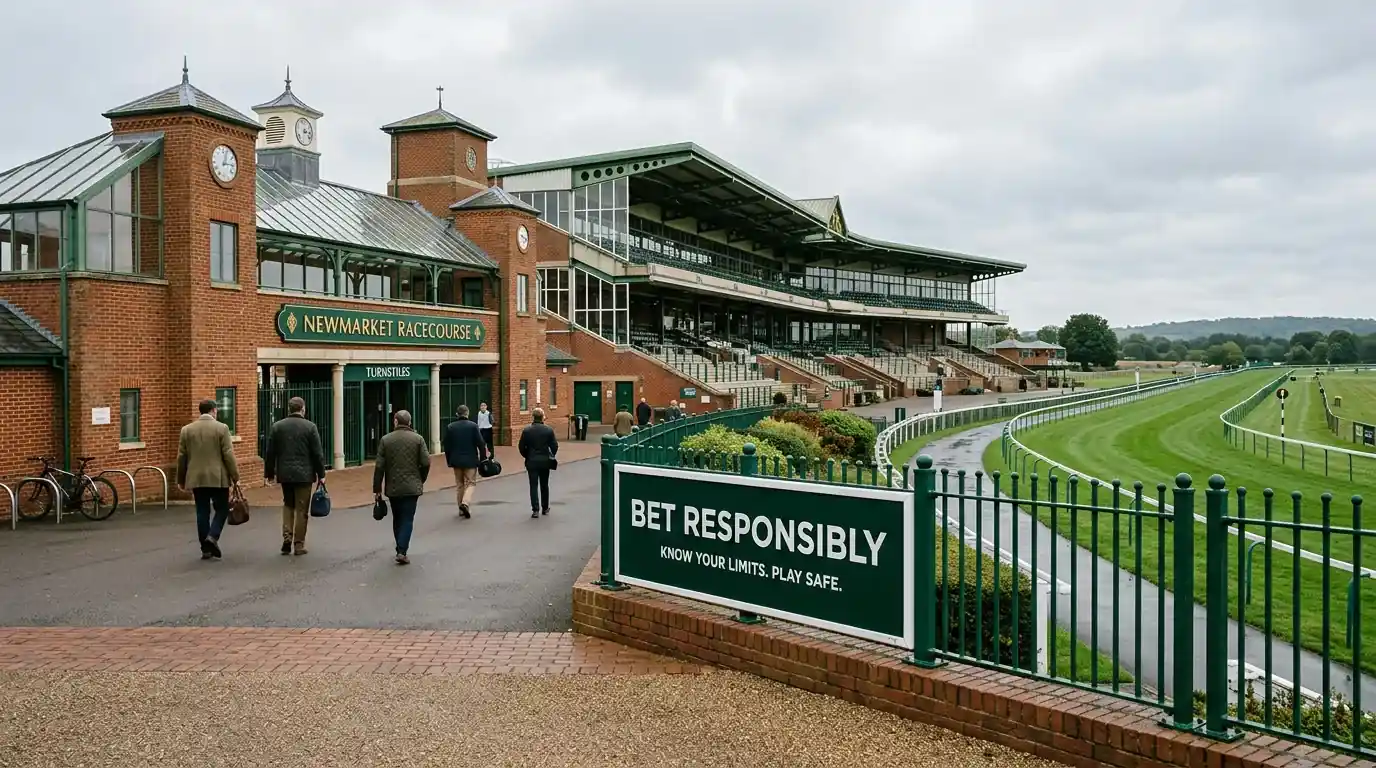
The Unlicensed Market and Its Impact on Racing
In 2020, unlicensed operators controlled less than 0.5% of the UK online market. By the first half of 2025, that share had surged to approximately 9%, generating an estimated £379 million in GGY. The Betting and Gaming Council puts the annual figure for unlicensed online gambling at roughly £2.7 billion — money that sits entirely outside the regulated system.
For racing, every pound wagered with an unlicensed operator generates no Levy contribution, no tax revenue, and no prize-money funding. The Levy yield hit a record £108 million in 2024/25, but that figure would be materially higher if even a fraction of black-market turnover were recaptured. Enforcement is under way — the DCMS Minister has committed resources to pursuing unlicensed sites — but offshore digital gambling makes enforcement slow and often futile. The practical lesson for punters: unlicensed operators offer no recourse if something goes wrong, and their odds are often worse than regulated alternatives.
The UK Live Betting Calendar: Key Fixtures
Every year around late February, my preparation routine shifts gear. The notebooks come out, the exchange accounts get topped up, and I start mapping which races across the next eight months offer the best in-play conditions — meaning high liquidity, live streaming, and fields large enough to generate meaningful price movement. The UK racing calendar is dense: roughly 1,500 meetings a year across 59 racecourses, split between the Flat season (April to November) and the National Hunt season (October to April, with overlap). But not all meetings are created equal for live betting purposes.
Cheltenham Festival (March)
Four days, 28 races, all National Hunt. Every race in 2025 ranked inside the top 31 by seasonal betting turnover. The highest-liquidity jump racing event in the calendar, and the week where in-play exchange markets are deepest.
Aintree / Grand National (April)
Three-day festival headlined by the Grand National, which alone generates over £200 million in betting turnover. The 40-runner field produces extreme in-play volatility — odds swing wildly after every fence in the National itself.
Royal Ascot (June)
Five days of elite Flat racing. Large-field handicaps on the Tuesday and Saturday offer the best each-way and in-play value. Ascot’s straight course produces a different in-play dynamic from galloping tracks — front-runners are visible for longer, and the market reprices more gradually.
Epsom Derby Festival (June)
Two days anchored by the Derby itself. The unique camber and undulations of Epsom make it one of the hardest races to trade in-play — the downhill run to Tattenham Corner creates sudden, sharp price moves that punish slow reactions.
Glorious Goodwood (July-August)
Five days of high-quality Flat racing on an undulating track. The large fields in Goodwood handicaps produce some of the best each-way value of the summer.
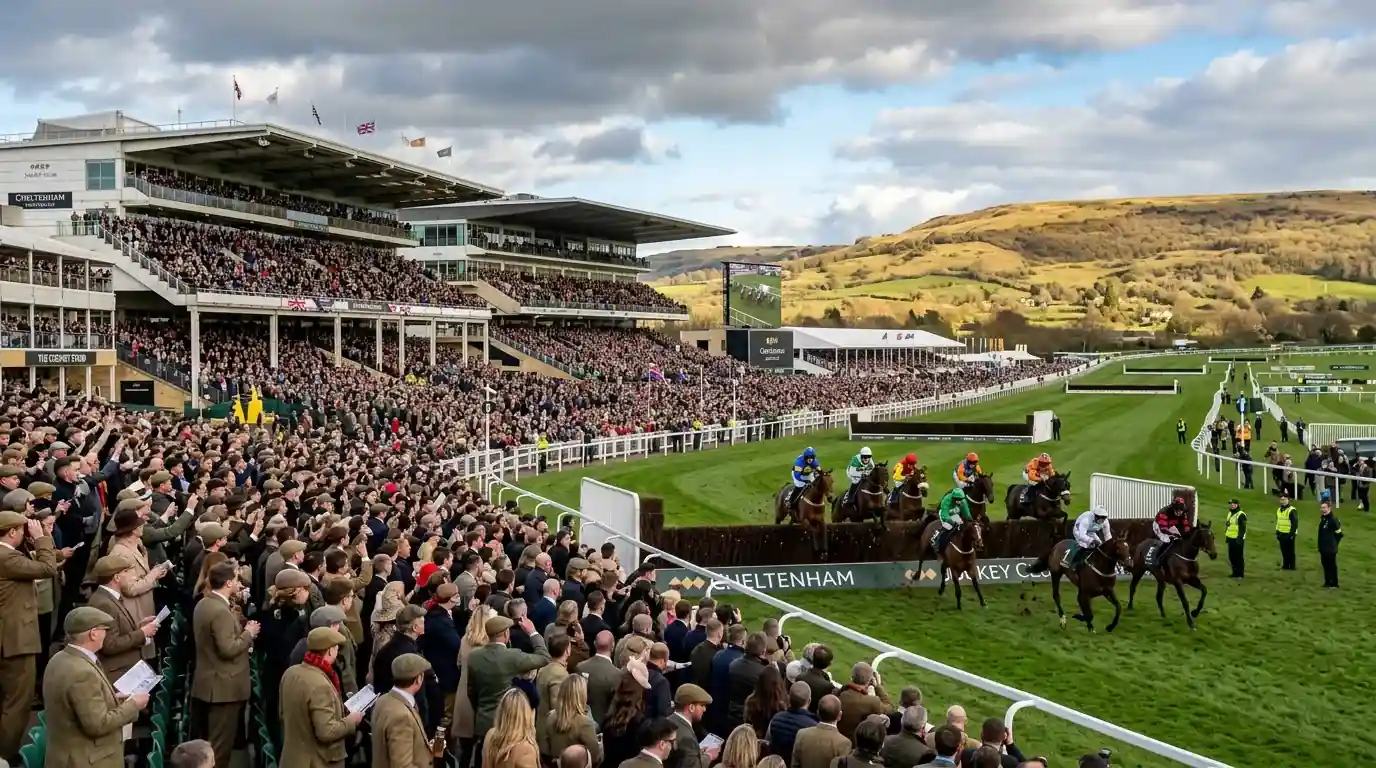
For in-play punters, the practical takeaway is about timing. The deepest exchange markets, the most competitive bookmaker odds, and the richest streaming coverage all converge during these peak windows. If you are selective about when you trade in-play — targeting festival weeks and Premier fixtures rather than grinding through Tuesday evening cards at minor tracks — you start with a structural advantage in terms of both market quality and information availability. The Flat and National Hunt seasons overlap in October and April, creating a brief window where both codes run simultaneously and the in-play calendar is at its densest.
Staying in the Game: A Quick Note on Discipline and Safety
I have watched sharp, intelligent punters blow through their bankrolls not because they lacked knowledge but because they lacked structure. The temptation in live racing is relentless — another race in twenty minutes, another price that looks wrong, another chance to recover a losing afternoon. Roughly 15% of UK adults bet on racing at least monthly, and in the 25-34 demographic, nearly a third do. Most of them will never develop a problem. But the speed and accessibility of in-play mobile betting compresses decision cycles in a way that amplifies impulsive behaviour, and ignoring that reality is not bravery — it is negligence.
Discipline in this context means concrete things: a pre-set daily loss limit that you actually honour, a staking plan that caps individual bets at a fixed percentage of your bankroll, and a willingness to close the app after a losing sequence rather than chasing. Every licensed UK operator offers deposit limits, session timers, and self-exclusion tools. Using them is not a sign of weakness; it is a sign that you treat betting as a financial activity with defined risk parameters rather than an emotional outlet.
If you or someone you know is struggling with gambling, the National Gambling Helpline (0808 8020 133) and GAMSTOP self-exclusion service are available around the clock. I will not pretend that a paragraph at the end of a betting guide solves a complex problem, but I will say this: the edge I have spent nine years building is worthless without the discipline to protect it. Bankroll management and responsible gambling are not footnotes to strategy — they are the foundation.
Before you act on anything in this guide, the FAQ below addresses the most common questions I hear from punters entering the live horse racing market for the first time.
Common Questions About UK Live Horse Racing Betting
How does live (in-play) betting work in horse racing?
After a race starts, bookmakers and exchanges continue accepting wagers at odds that update in real time. A horse that leads the field shortens; one that loses ground drifts. On an exchange, you can back or lay during the race; on a traditional bookmaker, typically only win bets are available in-running. The sharpest price movements happen in the first thirty seconds after the off and in the final two furlongs. A live video stream — delayed by one to three seconds — is the primary tool punters use to inform these decisions.
What is Best Odds Guaranteed (BOG) and how does it work?
BOG means that if the Starting Price ends up higher than the price you took pre-race, you are paid at the better price. If the SP is lower, you keep your original odds. Most major UK operators activate BOG from 08:00 or 09:00 on race day and apply it to win and each-way bets on UK and Irish racing. It does not cover in-play bets, forecasts, or tricasts. Over a season, BOG adds measurable percentage points to a punter’s return.
What is the difference between exchange betting and traditional bookmakers for horse racing?
A bookmaker sets odds, takes your bet, and profits from the overround built into every market. An exchange matches backers with layers and charges commission on net winnings (typically 2-5%). Exchange odds are usually better because commission is lower than a typical overround. The trade-off is liquidity: in less popular races, your exchange bet may go unmatched, whereas a bookmaker always accepts wagers up to their liability limit.
What are each-way bets in horse racing and when should I use them?
An each-way bet splits your stake into a win bet and a place bet. The place portion pays at a fraction of the win odds — typically one quarter or one fifth. Place terms depend on field size: five to seven runners pay two places, eight to fifteen pay three, sixteen-plus pay four. Each-way bets offer the best value in large-field handicaps at longer odds, where the place portion alone can return a profit. Major festivals often extend place terms to five or six positions, improving expected value further.
How do I read horse racing odds in fractional and decimal format?
Fractional odds like 5/1 mean £5 profit per £1 staked. Decimal odds like 6.0 represent total return per unit staked, including the stake. To convert: divide the first number by the second, add one (5/1 = 6.0). To find implied probability: divide one by the decimal price (1/6.0 = 16.7%). If your own analysis gives a horse a higher chance than the market implies, you have found a value bet.
What are affordability checks and how do they affect horse racing bettors?
UK-licensed operators must run financial assessments on customers whose net deposits exceed £150 per month (since February 2025). Enhanced checks at higher thresholds may involve credit-agency data and income verification. These can result in deposit limits or account restrictions. The racing industry argues the checks have contributed to falling turnover and driven some punters toward unlicensed operators that apply no protections at all.
Which horse racing events are the most popular for live betting in the UK?
Cheltenham Festival (March) tops the calendar — every one of its 28 races in 2025 ranked among the season’s highest-turnover events. The Grand National at Aintree (April) generates over £200 million in betting turnover on the headline race alone. Royal Ascot (June) is the premier Flat festival. The Epsom Derby and Glorious Goodwood round out the peak window. These festivals offer the deepest exchange liquidity and most comprehensive streaming coverage for in-play trading.
Created by the ”Live Betting Horse Racing” editorial team.